
Fellow Pilgrims: John Wesley
John Wesley's Doubt: The Preacher Who Struggled With Assurance
Each month, we meet someone who walked this path before us. Not perfect saints with easy answers, but real people who wrestled with doubt, faced crisis, and discovered faith through struggle. These profiles explore how historical and contemporary Christians navigated the same questions that we still struggle with. Their honest journeys remind us that faith isn’t about having everything sorted; it’s about staying on the path even when we can’t see where it leads. Read the rest of the Fellow Pilgrims series here:
There’s a cottage on our village green with a stone pulpit built into its outside wall. I walk past it most mornings—usually thinking about shopping lists or whether I remembered to lock the vestry. But yesterday I actually stopped and looked at it properly.
There is no blue plaque, but it’s clearly from the 1700s— most likely a Methodist preaching station. And I found myself wondering: Did John Wesley himself ever stand here? Did he climb up to this weathered stone ledge and preach to villagers who couldn’t fit inside the church—or weren’t welcome there?
These outdoor pulpits dot the British landscape, easy to miss if you’re not looking. Embedded in cottage walls, standing in village squares, often marked by small plaques or names like ‘pulpit lane’, ‘preacher house’, and so on. They’re monuments to a man who was refused church buildings, so he preached in fields instead. And in the process, he accidentally sparked a revival that reshaped British Christianity.
But here’s what nobody tells you: the man who stood at those pulpits preaching assurance spent decades doubting his own salvation.
The Crisis and the Warming
In 1735, John Wesley sailed to Georgia as a missionary. He was 32, ordained, Oxford-educated—going to convert Native Americans and bring the gospel to the colonies. Instead, he failed spectacularly. He alienated colonists, made no inroads with indigenous peoples, and eventually fled to avoid legal trouble. His journal entry on the return voyage cuts to the bone:
“I went to America to convert the Indians (sic); but oh! who shall convert me?”
During the Atlantic crossing, a storm nearly sank the ship. German Moravian passengers sang hymns, completely calm. Wesley was terrified. He realised these simple believers possessed something he lacked—confidence that if the boat went down, they’d be safe with God.
Back in England, he met the Moravian Peter Böhler, who taught that salvation came through faith alone, not works. Wesley grasped this intellectually but couldn’t feel it. The head knew; the heart didn’t.
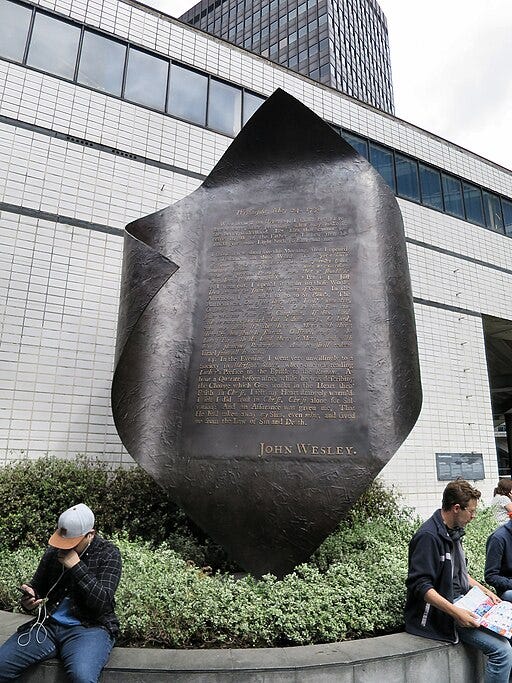
Then came 24 May 1738. Wesley “unwillingly” attended a meeting on Aldersgate Street in London. Someone was reading Luther’s preface to Romans. At about quarter to nine that evening, something shifted: “I felt my heart strangely warmed. I felt I did trust in Christ, Christ alone for salvation; and an assurance was given me that He had taken away my sins, even mine.”
This is what we remember—the warmed heart, the assurance, the certainty that launched Methodism. So famous that it has a statue on the site, now just outside the London Museum.
Last month’s Fellow Pilgrims explored Augustine’s dramatic conversion—the voice in the garden, tolle lege, the complete transformation that held for the rest of his life. Wesley’s Aldersgate sounds similar. But Augustine’s conversion held. Wesley’s assurance faded. Maybe that’s why Wesley speaks to more of us. We’re not Augustines. We’re people who have moments of clarity followed by years of fog.
Why Outdoor Pulpits Exist
By 1739, George Whitefield had persuaded Wesley to preach outdoors to coal miners in Bristol. Wesley was horrified. His journal records that he
“submitted to be more vile.”
Born in 1703 at Epworth rectory in Lincolnshire, son of an Anglican priest, Oxford Fellow, ordained priest—he should have had access to every pulpit in England.
But church doors kept closing. Respectable clergy thought field preaching was vulgar, the Archbishop of Canterbury called it “pretended extraordinary inspiration,” and Wesley’s own brother begged him not to carry things to extremes. So Wesley preached wherever people would listen—fields, town squares, cottage walls.
This was social rebellion as much as religious revival. Those Kingswood colliers were too dirty for respectable churches even if they’d been welcome. The labourers couldn’t afford decent clothes for Sunday services. This was Britain on the cusp of the Industrial Revolution, with new working classes emerging that the established church had no idea how to reach.
Over 54 years, Wesley preached more than 40,000 sermons, travelled 250,000 miles on horseback across the British countryside and industrial towns. You can still trace his routes—Methodist chapels mark where he preached, buildings bear plaques, and his house in Bristol is preserved as a museum.
That’s what the pulpit on my village green represents. And the man who perhaps stood there preaching God’s love spent decades wondering if God loved him.
The Doubt That Wouldn’t Go Away
Wesley’s journals reveal the ongoing struggle. In 1766—28 years after Aldersgate—he wrote:
“For many years I have been tossed by various winds of doctrine.”
In 1774, he confided to his brother Charles about spiritual dryness. His biographer Henry Rack notes that Wesley experienced “alternating moods of confidence and doubt” throughout his life.
Many of us have avoided Lent services and practises over the years. Probably because we don’t feel particularly penitent or holy or anything much spiritual at all. We may go through the motions and wonder if it counts when we’re not feeling it. If that sounds like you, remember Wesley and think maybe that’s exactly when it counts most.
He developed what he called sanctification—ongoing growth rather than a one-time fix. “Christian Perfection” didn’t mean sinless but “perfect love”—complete devotion despite human limitations. Assurance might come and go, but faithfulness could remain constant.
When I walk past that outdoor pulpit, I wonder: Did Wesley ever look across this particular green? And even if he didn’t, how many times did Wesley climb up other pulpits, doubting whether he had any right to preach? How often did he proclaim truths he struggled to feel? His uncertainty didn’t disqualify him from ministry. It might have made him better at it. He understood strugglers because he was one.
Wesley emphasised “means of grace”—prayer, Scripture, the Lord’s Supper, fasting, Christian conferencing (talking about faith with others). Not to earn salvation but to stay connected when you don’t feel connected. His class meetings asked brutal questions: “What known sins have you committed since our last meeting? What temptations have you faced?” Try that in a British church today. We’d call it intrusive, boundary-violating. We prefer privacy to accountability, individual spirituality to communal oversight. Maybe that’s why we’re lonely, and Wesley’s people weren’t.
More Than Personal Piety
Wesley insisted,
“[T]here is no holiness but social holiness.”
Personal devotion and social action were inseparable. He founded schools, orphanages, and medical dispensaries. He campaigned against slavery—his last letter, written in February 1791, just days before his death, encouraged William Wilberforce to continue the fight.
The outdoor preaching wasn’t just about saving souls. It was justice for people the church had written off. Coal miners who were too dirty for respectable pews. Women who worked too hard to make Sunday services. Wesley believed God loved them just as much as the comfortable folks inside.
That pulpit on my village green marks where faith reached people the establishment ignored. But it also marks something Wesley discovered: serving others helps when you don’t feel God’s presence yourself. The work continues whether your heart feels warm or not.
Walking Through Dry Seasons
I see that cottage pulpit differently now—not as quaint heritage but as a theological statement. Wesley preached from outdoor ledges because the church wouldn’t have him preach inside. His warmed heart went cold again. The assurance came and went. But he kept climbing up, kept preaching, kept serving.
Over the years, more than a few parishioners have confessed something along the lines of:
“I don’t feel saved. I read about people’s conversion experiences, and I’ve never had that. Am I even a Christian?”
I think about Wesley—how his famous heart-warming came when he was already a priest, already serving, already preaching. How the assurance he found that night didn’t end his struggles but changed how he understood them.
Wesley would say feelings aren’t the measure of faith. Some seasons feel spiritually alive; others feel like going through motions. Both are normal. What matters is continuing the means of grace even when they feel empty. Prayer, when it seems pointless. Scripture, when it sounds dead. Communion, when it feels like just bread and wine. Christian community, when you’d rather stay home.
These practices aren’t performance for God’s approval. They’re staying on the path when visibility drops. Wesley’s class meetings gave people space to admit struggle without being told they lacked faith. We need those spaces—small groups where doubt doesn’t disqualify you, where fellow pilgrims walk alongside through dry seasons.
We’re approaching Lent, that season of honest self-examination and renewed practice. Wesley’s struggle with assurance, alongside his commitment to the means of grace, offers a model: acknowledge the doubt whilst continuing the disciplines. Don’t pretend to feel what you don’t. But don’t stop walking either.
Wesley died at 87, his last words: “Best of all, God is with us.” Not “I always felt God” but “God is with us”—present even when unfelt, constant even when our confidence wavers.
Next time you pass a Methodist chapel or outdoor pulpit, remember what it represents—excluded people hearing good news. A doubting preacher who climbed up anyway. Faith that keeps walking when feelings fade. That’s pilgrimage—continuing despite uncertainty, together rather than alone, toward a God who remains constant even when our confidence doesn’t.
Questions for Fellow Pilgrims
Have you walked past Methodist history without noticing—chapels, burial grounds, preaching stations? What would it mean to see them as theological statements, not just heritage?
Do you relate more to the “warmed heart” story or the decades of doubt that followed? Why do we celebrate conversions but hide ongoing struggles?
What “means of grace” sustain you when feelings fade? Which practices have you abandoned that might be worth recovering?
Going Deeper
Essential Reading:
Henry D. Rack, Reasonable Enthusiast: John Wesley and the Rise of Methodism (1989)
Randy L. Maddox, Responsible Grace: John Wesley’s Practical Theology (1994)
Kenneth J. Collins, The Theology of John Wesley: Holy Love and the Shape of Grace (2007)
Primary Sources:
John Wesley, Journal (various editions)
Albert Outler, ed., John Wesley’s Sermons: An Anthology (1991)
For Further Exploration:
Our January Fellow Pilgrims piece on Augustine explored another dramatic conversion—but one that held.
“How Do We Know What’s True?” examines how Wesley’s emphasis on experience shaped Methodist theology.
Watch for our upcoming Lent series on spiritual disciplines, where Wesley’s “means of grace” will provide a framework.